If you want to stop stress eating on busy workdays, these two Mondays may look familiar. On the first Monday, everything begins beautifully. You cooked, meal-prepped, packed your lunchbox, and even brought an afternoon snack. Plan A is working.
Then work takes over. You stay late several nights. The demanding day becomes a demanding week, and maybe work even follows you into the weekend. The time and energy that normally support grocery shopping and cooking disappear.
By the following Monday, it is a completely different Monday. You did not have the time or energy to plan meals for the week. By late afternoon, you are stressed, exhausted, and extremely hungry. You choose whatever is fastest, your sleep may suffer, and the next morning you wake up tired, rushed, and unprepared again.
| One stressful workday has now created a cascade of problems. |
Then you tell yourself, “I stress ate again.” But that label may be incomplete. Was this emotional eating, or did stress disrupt lunch, eliminate your backup food, and leave you with true physical hunger by the end of the day? Stress may have started the cascade, but your body still needed food.
You do not need a stricter diet for days like these. You need a flexible food policy that tells you what to do when your schedule—and your original plan—fall apart.
Why Stressful Workdays Create a Stress-Eating Cascade
Stress does not affect everyone the same way. Some people eat more, some eat less, and some notice very little change. What we do know is that stress can interfere with executive function and self-regulation while also influencing behavior and sleep, according to research. In real life, it also steals time. Meetings move, lunch gets delayed, shopping does not happen, and the meal you expected to eat is suddenly unavailable.
This is where emotional appetite and physical hunger can collide. If you ate a satisfying lunch and an upsetting email immediately made you want the cookies in the break room, the emotion may have awakened your appetite. But if lunch never happened and it is now five o’clock, your body needs nourishment. You cannot distract your way out of physical hunger.
Before calling the experience emotional eating, learn how to recognize the difference between physical and emotional hunger. Ask yourself: Do I need nourishment, emotional relief, or both? The answer determines which tool belongs next.
A Flexible Food Policy Is Not Another Diet
A rigid diet gives you one route and calls every detour a failure. A flexible food policy gives you structure, boundaries, and backup options. It is not permission to stop caring about nutrition. It is a decision-making system that keeps one difficult day from becoming an abandoned week.
That distinction matters. In one study of women participating in a commercial weight-loss organization, flexible restraint was associated with greater weight loss and better maintenance, while rigid restraint was associated with less weight loss. The study does not prove that flexibility causes better results, but it supports a principle I have seen repeatedly in practice: a plan must be adaptable enough to survive real life.
Your policy can use simple if-then decisions. If lunch is delayed, then you eat a backup snack before your hunger becomes extreme. If you must work late, then you eat a bridge snack before leaving. If there are no groceries, then you use a Plan B meal or one of your preselected restaurant orders. You make the decision before exhaustion makes it for you.
Plan A: When Your Food System Is Working
Plan A does not mean your workday is stress-free. It means stress has not yet disrupted the system that supports your eating. You cooked, meal-prepped, packed your lunchbox, and brought your afternoon snack. The food is available, so your eating can continue more or less as planned even when the work itself becomes overwhelming.
A strong Plan A includes satisfying meals with protein, fiber-rich carbohydrates, produce, and flavor. It also includes a planned snack when there will be a long gap between meals. The goal is not to eat by a perfect clock. The goal is to avoid arriving at dinner so hungry that every decision becomes harder.
But Plan A requires maintenance. Someone has to shop, cook, portion, and restock. When work consumes the evening and then the weekend, that maintenance does not happen. You may not even want to open the grocery app because it feels like one more task. You want to close the laptop, sit down, and finally relax.
| And Plan A? Poof! Gone. |
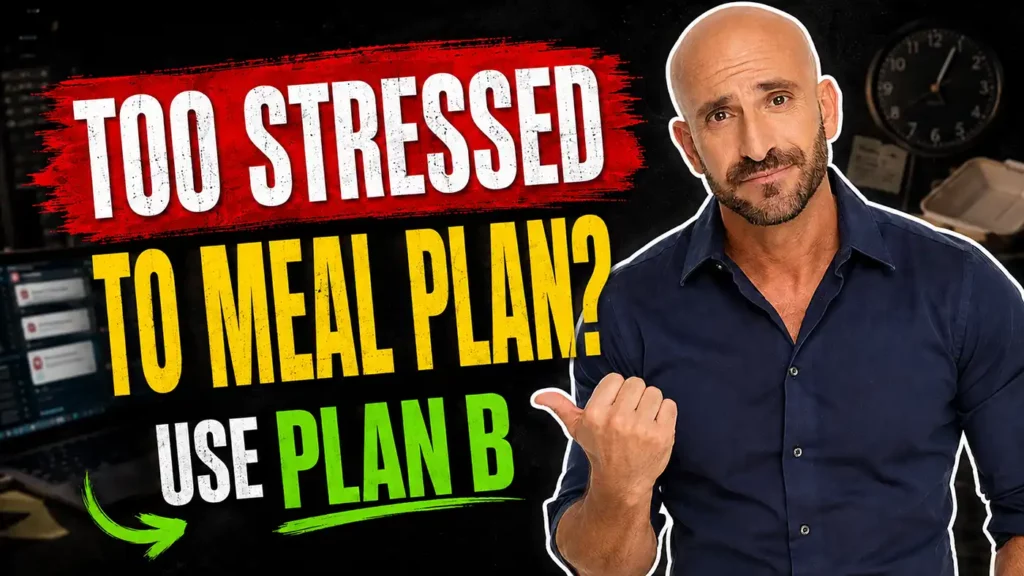
That is exactly why Plan B is not a failure or a lower-quality version of healthy eating. Plan B is the system designed for the moment when work has consumed the time and energy that Plan A required.
Plan B: Become a Meal Assembler
During stressful weeks, I tell my clients to stop trying to be a cook or a chef. Become a meal assembler. Your Plan B policy is simple: keep ingredients for at least two satisfying meals that can be assembled in 15 minutes or less.
Use this formula: protein + a satisfying carbohydrate + produce + flavor. These foods can come from the freezer, a can, a jar, or a package. The goal is not a tiny frozen “diet dinner.” The goal is a complete meal that feels like dinner and requires very little decision-making.
Plan B Dinner #1: A Salsa Verde Bowl
Keep frozen cooked brown rice, canned black beans, cooked frozen chicken strips, frozen bell peppers with onions, and salsa verde. Heat the ingredients, assemble the bowl, and finish it with salsa. If avocado, cilantro, or Greek yogurt happens to be available, add it—but the meal must still work when the refrigerator looks sad. In less than 15 minutes, you have protein, carbohydrates, fiber, vegetables, and flavor.
Plan B Dinner #2: Italian Night
Boil pasta while heating bottled marinara and frozen cooked turkey meatballs. Add frozen spinach or broccoli, or open a bagged salad. Boom—dinner is ready before delivery would arrive. Healthy eating does not have to be cooked from scratch to count.
Let Plan B Live at Work Too
If your workplace has a freezer, bring two extra meals during a calmer Plan A day. Label each one with your name and the date so you know how long it has been there—and so Rosita does not eat your dinner. A bridge snack can also live in your desk or work bag. The less your backup depends on memory, the more likely it is to help when the day becomes chaotic.
But Aren’t Packaged Foods Too High in Sodium?
This is when my BS detector comes out. Are we pretending the restaurant meal ordered while you are starving is automatically high in fiber, cooked with measured healthy fat, loaded with vegetables, properly portioned, and low in sodium? Right.
Some packaged foods are higher in sodium, so compare labels when sodium is a concern for you. But frozen, canned, jarred, and packaged foods are not automatically nutritionally useless. Meal assembly lets you choose the ingredients, control the portions, add beans and vegetables, and spend less than you may spend on last-minute restaurant food. Nutrition does not need to be 100 percent perfect to be useful.
What to Do When Plan B Is Not Around
Sometimes the freezer is empty and the backup meal was never restocked. You still do not need to surrender the entire day. Take the same meal-assembly formula outside your kitchen.
Use the Grocery Store as Your Kitchen
Combine rotisserie chicken with a prepared salad and microwaveable rice or whole-grain bread. Pair a lentil soup with a salad and an easy protein. Choose sushi with edamame and fruit. These are not emergency “cheat meals.” They are practical meals assembled from foods someone else prepared.
Create a Restaurant Policy Before You Need It
Choose two or three go-to dishes from the restaurants you visit most often. Decide which meals fit your needs before the stressful day arrives, then save those same orders in your delivery app. You still have choices, but the exhausting part of the decision has already been made. This is a workday version of the personal food policies I use with clients.
Use a Bridge Snack
If dinner will be late, eat a bridge snack before your commute or before opening the restaurant menu. A protein bar, Greek yogurt, fruit with nuts, or another satisfying option can bring your hunger down from an emergency to a manageable level. If bars are convenient for you, use these dietitian guidelines for choosing bars that provide meaningful protein and fiber.
Where the 3 Ds Fit
The 3 Ds—Distance, Delay, and Distract—belong when you recognize that the urge is emotional rather than a request for nourishment. First, create distance from the food. Second, delay the automatic response with a short pause, such as ten slow breaths or ten minutes. Third, distract yourself with an activity that gives your attention another target.
But remember: the 3 Ds do not replace lunch. If your body needs food, eat. This framework helps interrupt automatic emotional eating; it is not a tool for ignoring physical hunger. The goal is to respond to the correct need.
Audit the System, Not Your Character
At the end of the week, take five minutes and look upstream. Do not begin with, “Why did I eat that?” Ask, “Where did the cascade begin?” Did lunch keep getting delayed? Did you run out of backup meals? Did you need a bridge snack before your commute? Did your restaurant order leave you satisfied?
This is not a judgment audit. It is a systems audit. Keep what reduced friction. Change what felt tedious. Restock what worked. A good food policy is allowed to evolve as your job, schedule, energy, and season of life change.
The Bottom Line
A stressful workday does not mean you failed your plan. It may simply mean your plan needed another option. Your backup dinner may not be the beautiful meal you imagined when you planned the week, but if it nourishes you, protects your energy, and prevents one difficult day from becoming an abandoned week, that imperfect meal may work wonders.
| Sometimes, an imperfect plan works wonders because it is the plan you can still follow when life is anything but perfect. |
You do not stop stress eating by demanding perfection from yourself. Your food policy needs to help you adapt without abandoning yourself. If you want personalized help building a nutrition system around your real schedule, explore my services. For busy San Francisco clients who want the planning and cooking handled for them, my customized meals provide another way to reduce friction without sacrificing flavor.
Stop Dieting. Start Living.
Frequently Asked Questions
Is stress eating always emotional eating?
No. Stress can trigger emotional appetite, but it can also delay meals, eliminate food preparation, and leave you physically hungry. Look at when you last ate, whether the meal was satisfying, and what happened immediately before the desire to eat appeared.
What is a Plan B meal?
A Plan B meal is a satisfying backup meal assembled in about 15 minutes or less. It should include a useful source of protein, a satisfying carbohydrate, produce, and flavor. It is designed for the days when shopping and cooking did not happen.
Are frozen, canned, and packaged foods unhealthy?
Not automatically. Nutrition varies widely across packaged foods. Compare labels when you need to manage sodium or another nutrient, then combine convenient ingredients in a way that provides protein, fiber, produce, and satisfying portions.
What if I have no Plan B food at home?
Use a rescue option. Assemble a meal from the grocery store, choose one of your predetermined restaurant meals, use a saved delivery order, or eat a bridge snack while you obtain dinner. The goal is to prevent extreme hunger from making every choice harder.
Can flexible eating still support weight loss?
Yes. Flexible does not mean unstructured. It means creating several realistic routes toward the same goal. A flexible policy can preserve portions, meal balance, and intentional choices while allowing you to adapt when life does not cooperate.
When should I seek professional support?
If eating repeatedly feels uncontrollable, causes significant distress, or includes recurrent binge episodes, a food policy alone may not be enough. Speak with a qualified healthcare professional or eating-disorder specialist for individualized evaluation and support.
References
- https://pubmed.ncbi.nlm.nih.gov/29927688
- https://pubmed.ncbi.nlm.nih.gov/23265405
- https://pubmed.ncbi.nlm.nih.gov/33259829