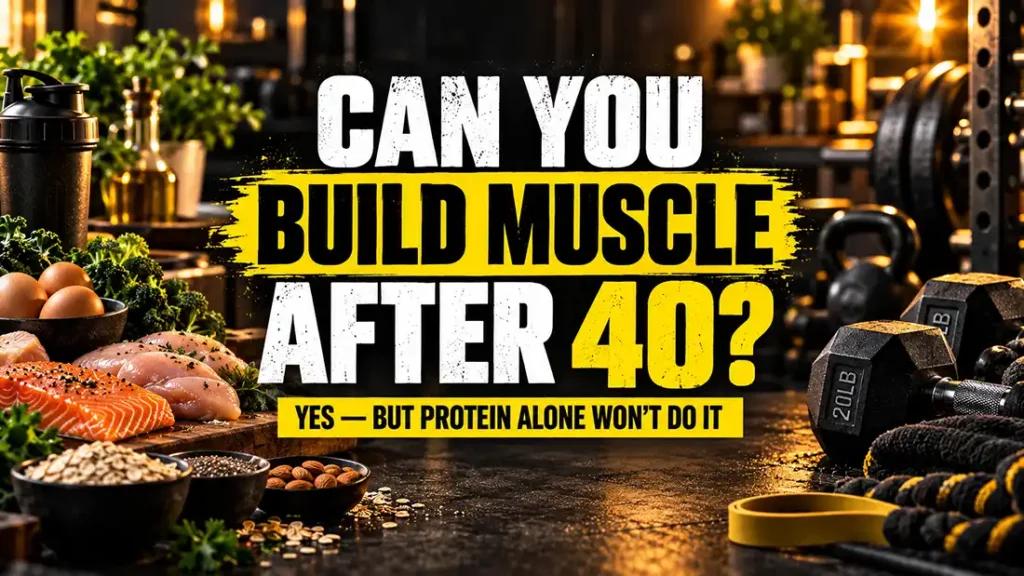
Can you still build muscle after 40? Absolutely.
Your muscles did not get the memo that you turned 40.
But building and maintaining muscle does become a little more intentional as we get older. That does not mean your body suddenly loses the ability to get stronger. In fact, research in adults well beyond age 40 shows that resistance training can still increase muscle size and strength.
A 2024 systematic review of adults age 65 and older found that resistance training produced significant muscle hypertrophy, demonstrating that older muscle remains responsive to training.
The difference is that you need to give your body the right signals.
You need resistance training.
You need enough protein.
You need enough food to support what you are asking your body to do.
And you need recovery.
This matters for much more than looking muscular. Maintaining muscle supports strength, mobility, metabolic health, healthy aging, and your ability to stay active and independent.
So if you want to build muscle after 40, here is what actually matters.
Yes, You Can Build Muscle After 40
Forty is not some magical age when muscle building stops.
As we age, muscle can become somewhat less responsive to the signals that stimulate muscle protein synthesis, sometimes referred to as anabolic resistance. But less responsive does not mean unresponsive.
It means that the stimulus becomes more important. Resistance training tells your body, “We need this muscle.” Protein provides the amino acids your body uses to repair and build it.
They work together. Research consistently shows that resistance exercise and protein ingestion both stimulate muscle protein synthesis and have complementary effects.
You could eat chicken breast all day long, but if you never challenge your muscles, your body has very little reason to build bigger, stronger muscle.
On the other hand, you can lift weights consistently, but if you chronically under-eat and do not provide enough nutrition, you are making recovery and adaptation much harder.
Think of muscle building as a partnership between training and food.
How Much Protein Do You Need After 40?
This is where people can go in two completely different directions. Some people are not eating enough protein. Other people have decided that protein needs to be added to everything—including their water.
You do not need to turn your entire diet into protein.
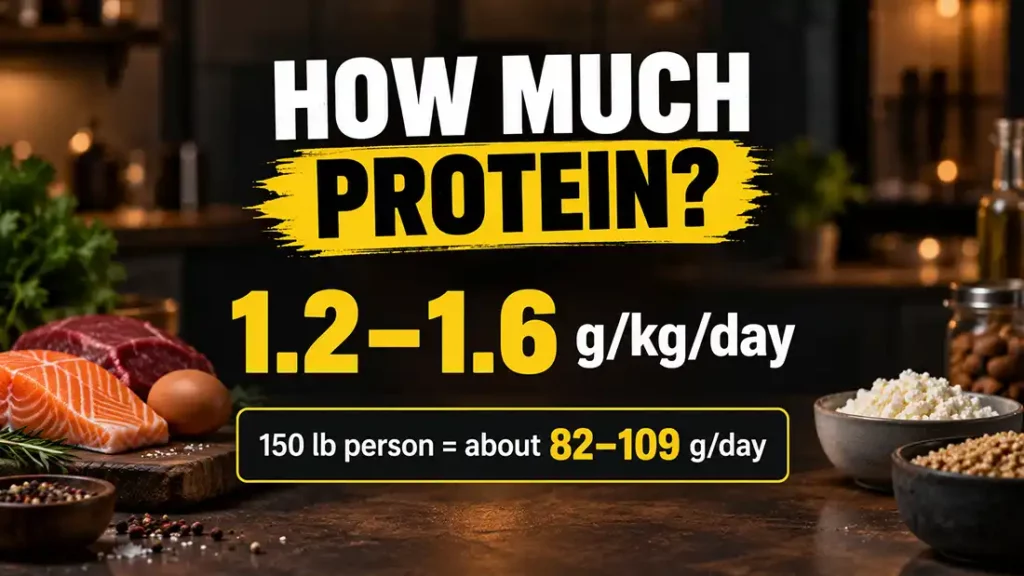
For an active adult trying to preserve or build muscle, a practical starting range is often around 1.2 to 1.6 grams of protein per kilogram of body weight per day, depending on age, activity, goals, total calorie intake, and training.
For someone weighing about 150 pounds, that works out to roughly 82 to 109 grams per day.
Research in active older adults supports protein intakes above the basic RDA, while research on resistance training suggests that benefits for gaining lean mass tend to level off around approximately 1.6 g/kg/day for many people.
That is a range, not a magic prescription.
Someone who weighs more, trains hard, or is dieting may need something different from someone who is smaller or less active. Medical history matters too. If you have kidney disease or another condition that affects protein recommendations, your intake should be individualized with your healthcare team.
But the bigger message is this: You probably do not need an extreme protein intake just because somebody at the gym told you that you do.
More is not automatically better. I go deeper into individual protein needs in my guide to protein for weight loss.
Don’t Save All Your Protein for Dinner
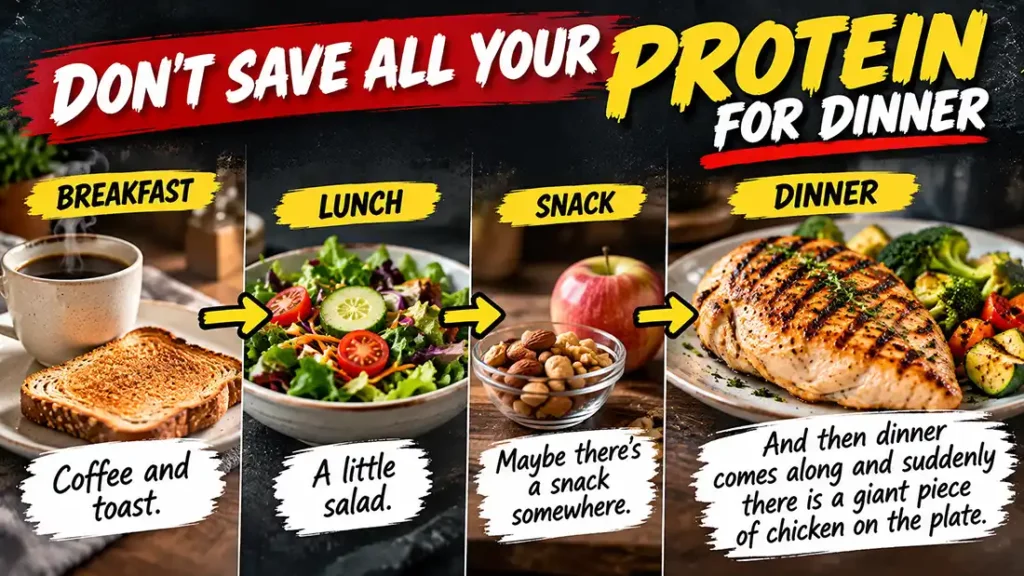
Here is a pattern I see all the time.
Breakfast is coffee and toast. Lunch is a little salad. Maybe there is a snack somewhere. Then dinner arrives and suddenly there is a giant piece of chicken on the plate. You may technically reach a reasonable amount of protein by the end of the day, but I would rather see some of that protein distributed across your meals.
Why?
Every time you eat a meal containing enough high-quality protein, the amino acids from that meal help stimulate muscle protein synthesis. But that response is not unlimited. Eating three times as much protein at dinner does not mean you suddenly stimulate three times as much muscle growth.
And that does not mean the rest of the protein is “wasted.” Your body can use amino acids for many other functions. It simply means that, from the standpoint of stimulating muscle protein synthesis, several meaningful protein-containing meals can give your muscles multiple opportunities to respond throughout the day.
How Much Protein Should You Eat Per Meal?
Research in aging adults commonly places a useful meal-sized dose in the neighborhood of 25 to 40 grams, depending on body size, age, protein quality, and the exercise stimulus.
So rather than putting nearly all your protein at dinner, think:
- Breakfast: a meaningful source of protein.
- Lunch: another opportunity.
- Dinner: another opportunity.
You do not need to pull out a calculator every time you sit down to eat.
- Breakfast might include eggs, Greek yogurt, cottage cheese, milk, or a protein-rich smoothie.
- Lunch might include chicken, fish, tofu, beans, lentils, or another protein food you enjoy.
- Dinner gets its share too.
The goal is not to make protein your entire diet. The goal is to give your muscles several good opportunities throughout the day to use it.
Your Muscles Need More Than Protein
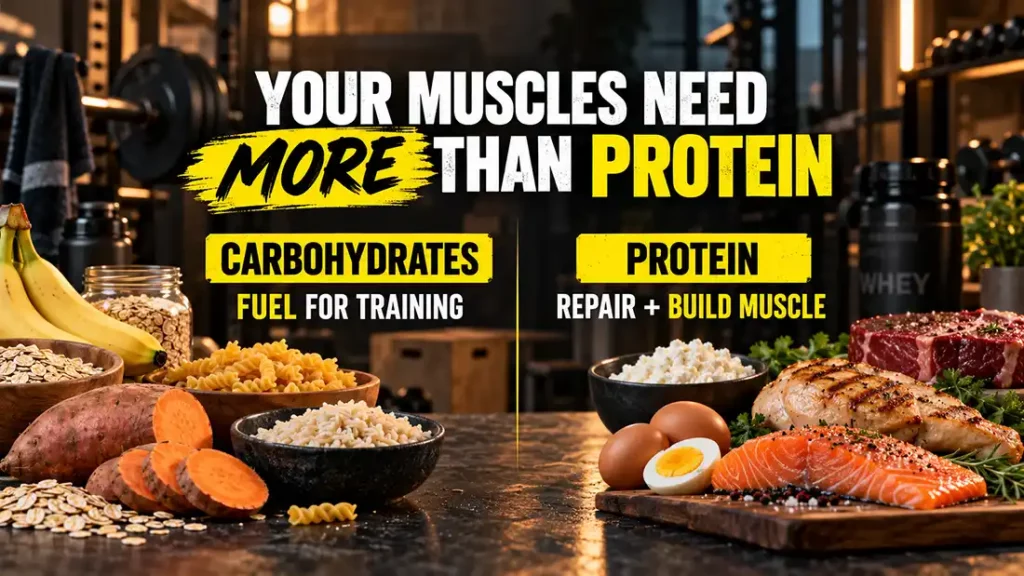
Protein gets so much attention that people sometimes forget one important detail:
Muscles need energy too.
Carbohydrates are one useful source of that energy, especially when training volume or intensity goes up. They also help maintain and replenish muscle glycogen—the carbohydrate stored inside muscle that can be used during exercise.
Now, this does not mean you need a massive high-carbohydrate diet to build muscle. Research on resistance exercise shows that carbohydrate needs depend greatly on training volume, whether you are training fasted, and how demanding the session is.
But there is an even bigger issue: under-fueling.
What Does Under-Fueling Do?
If you are chronically eating too little while simultaneously asking your body to train harder, recover, and build new tissue, you are creating competing demands.
You are saying: “Build muscle.”
And at the same time: “I am not going to give you very much fuel.”
That does not make a lot of sense.
Your body can use carbohydrate, fat, and—in some circumstances—amino acids to meet energy needs.
I would rather give your body adequate energy so protein can primarily do the jobs we want it to do, including muscle repair and remodeling. Or, to put it another way: Air is not fueling your workout.
If you are wondering when to fuel your exercise, I also cover whether to eat before or after a workout.
Balanced meals still matter.
Protein.
Carbohydrate.
Vegetables or fruit.
Healthy fat.
Food should still look like food.
Want to Lose Weight? Protect Your Muscle
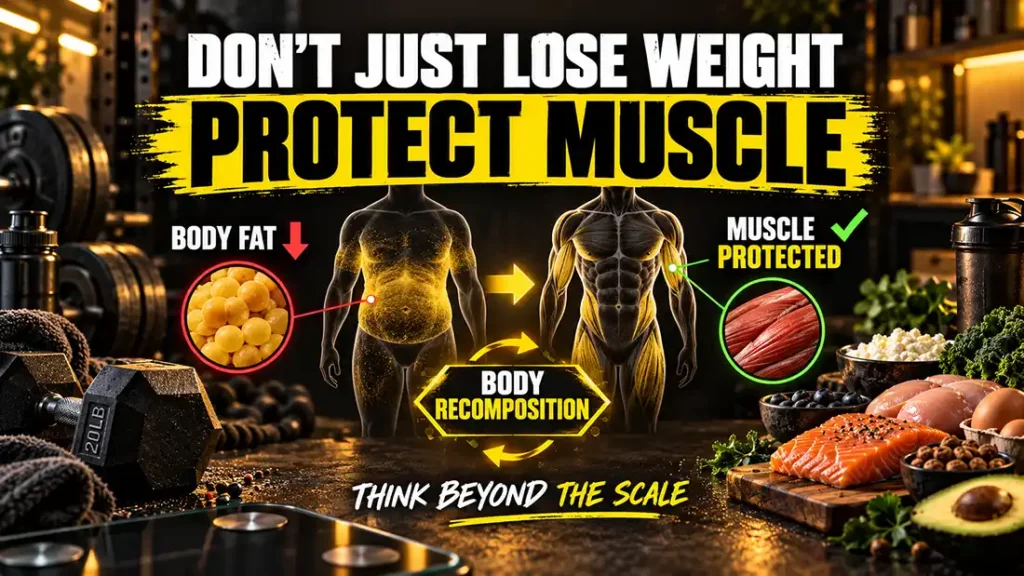
A lot of people tell me: “Manuel, I don’t want to build muscle. I just want to lose weight.”
I understand what they mean.
But I want you to think beyond the scale.
When you lose weight, you do not want all of that weight coming from lean tissue. The goal is generally to lose body fat while protecting as much muscle as possible.
This is why aggressive dieting can backfire.
Someone dramatically cuts calories, starts exercising more, gets increasingly hungry and tired, and then wonders why training quality and recovery fall apart.
Research shows that higher protein intake combined with resistance exercise can help preserve lean mass during a moderate calorie deficit. But as the energy deficit becomes more severe, even a higher protein intake becomes less effective at preventing lean-tissue loss.
That is why I do not believe in starving your way to a smaller body.
If fat loss is the goal, we want enough of a calorie deficit to produce progress while still giving your body enough nutrition to train, recover, and maintain muscle.
That is a very different strategy from simply eating as little as possible.
Depending on your starting point and training history, some people can also lose fat while gaining muscle—a change commonly called body recomposition.
And that is another reason the scale should not be your only measurement of progress. I talk more about this philosophy in my article on why eating more food can actually support weight loss.
You Have to Give Your Muscles a Reason to Grow
Nutrition cannot replace the actual training stimulus. If your goal is building muscle, you have to challenge your muscles. That could mean free weights, weight machines, resistance bands, or body-weight exercises.
You do not need to become a bodybuilder. You do not need to spend two hours in the gym. And you definitely do not need to lift the heaviest dumbbell you can find.
What matters is progression.
Over time, maybe you lift slightly more weight. Maybe you perform another repetition. Maybe your technique improves. Maybe an exercise that used to be difficult becomes easier and you progress to a more challenging version.
That tells your body it needs to adapt.
Current U.S. Physical Activity Guidelines recommend muscle-strengthening activity on at least two days per week for adults.
Walking is fantastic. Cardio is fantastic. Keep doing them. But they do not provide exactly the same muscular stimulus as resistance training. If your goal is to build muscle, you need to train your muscles.
Recovery Is Part of Building Muscle After 40
This is the part people love to ignore. You do not actually build muscle while you are lifting the weight. The workout creates the stimulus. Then your body needs time and nutrition to recover and adapt.
That means sleep matters. Rest matters. Eating enough matters. And you do not need to destroy yourself every time you exercise.
More exercise is not automatically better exercise. A productive program challenges your body and then gives it enough time to recover so you can return and challenge it again.
We can still train hard as we get older. We just need to train smart.
The Bottom Line
Can you build muscle after 40?
Absolutely.
Your age is not a deadline.
But building and preserving muscle works best when you give your body the right signals.
Challenge your muscles with resistance training.
Eat enough protein and spread meaningful amounts throughout your day.
Give your body enough overall nutrition and do not be afraid of balanced meals that include carbohydrates.
If weight loss is your goal, create a sustainable calorie deficit rather than slashing food so aggressively that you sacrifice the muscle you are trying to protect.
And give yourself time to recover.
Because building muscle after 40 is not about fighting your body.
It is about working with it.
The goal is not simply to weigh less.
The goal is to stay strong, capable, healthy, and confident in your body for decades to come.
Stop Dieting. Start Living.
FAQs
Can you really build muscle after 40?
Yes. Resistance training can increase muscle size and strength well beyond age 40. Aging may make muscle somewhat less responsive to training and protein, but it does not eliminate your ability to build muscle.
How much protein should I eat to build muscle after 40?
For many active adults, roughly 1.2–1.6 grams of protein per kilogram of body weight per day is a useful practical range, although individual needs vary based on body size, activity, goals, total calorie intake, and medical history.
Is 30 grams of protein per meal enough?
For many people, approximately 25–40 grams of high-quality protein per meal can provide a meaningful muscle protein synthesis stimulus. Larger adults and older adults may sometimes benefit from amounts toward the higher end of that range.
Do I need carbohydrates to build muscle?
You do not need an extremely high-carbohydrate diet, but carbohydrates are a useful source of exercise fuel and help replenish muscle glycogen. Needs depend on your activity level, training volume, and overall diet.
Can I build muscle while losing weight after 40?
It can happen, particularly in people who are newer to resistance training or who have more body fat to lose. Regardless, resistance training, sufficient protein, and a moderate rather than extreme calorie deficit are important for preserving lean mass during weight loss.